-
-
CALL US NOW
+91 78600 24700
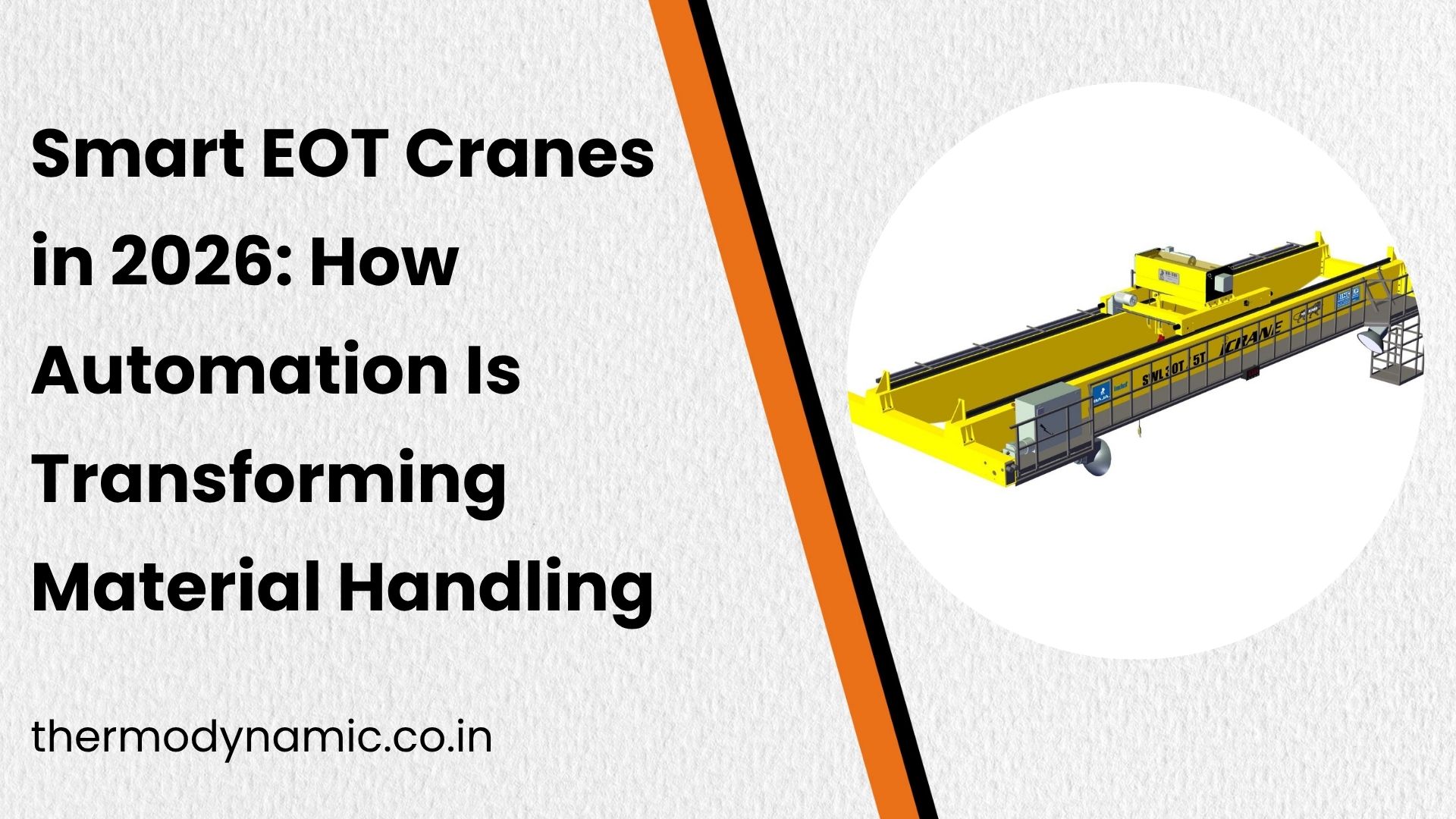
Material handling is becoming more intelligent as industries look for safer, faster, and more efficient ways to move heavy loads. In manufacturing plants, warehouses, engineering facilities, and infrastructure projects, Electric Overhead Travelling (EOT) cranes play an important role in lifting and transporting materials across defined work areas. With automation, sensors, remote monitoring, and advanced control systems becoming more accessible, modern EOT cranes are evolving beyond conventional lifting equipment.
For businesses searching for an EOT crane dealer in Uttar Pradesh, understanding these technological developments can help in selecting equipment that supports long-term productivity and operational safety. Smart crane systems can reduce manual intervention, improve load positioning, and provide better visibility into equipment performance.
An EOT crane is an electrically operated overhead lifting system designed to move heavy materials horizontally and vertically within industrial premises. It generally consists of a bridge, end carriages, a hoist, a trolley, electrical controls, and runway systems.
Traditional cranes depend heavily on operator control. Modern EOT cranes can integrate automation technologies that assist with movement, positioning, overload protection, diagnostics, and preventive maintenance. This makes them particularly valuable for facilities where repetitive lifting operations are performed throughout the day.
A reliable EOT crane dealer in Uttar Pradesh can help businesses assess lifting capacity, span, lifting height, duty class, control requirements, and installation conditions before selecting an appropriate configuration.
Automation enables cranes to move loads more accurately to predefined locations. This can minimize unnecessary movement and reduce the possibility of collisions or positioning errors.
Variable frequency drives allow smoother acceleration and deceleration. Controlled movement can reduce mechanical stress while improving handling precision, especially when transporting delicate or high-value materials.
Connected crane systems can collect information related to operating hours, load cycles, motor performance, and other equipment parameters. Plant teams can use this information to identify potential maintenance requirements.
Modern EOT cranes may incorporate overload protection, limit switches, anti-collision systems, emergency controls, and other safety features. These technologies can help create a safer working environment when properly designed and maintained.
Advanced control systems can identify certain operational abnormalities and provide useful maintenance information. This supports condition-based maintenance instead of relying exclusively on fixed maintenance schedules.
Automation can provide several operational advantages for industrial facilities. Improved positioning accuracy can reduce material damage and unnecessary movement. Smooth crane operation can also contribute to lower mechanical wear and longer component life.
Another major benefit is productivity. Automated or semi-automated systems can perform repetitive lifting tasks consistently, allowing operators to focus on supervision and other important activities.
Safety is equally important. Reducing unnecessary manual intervention can lower exposure to certain workplace hazards. Real-time operational information can also help maintenance teams respond to developing issues before they become major failures.
For procurement teams, selecting equipment through an experienced EOT crane dealer in Uttar Pradesh can make it easier to balance automation requirements with installation conditions, operating frequency, and budget considerations.
EOT cranes are widely used wherever heavy materials need to be lifted and moved within a controlled workspace. Common applications include manufacturing plants, steel processing units, fabrication workshops, automobile facilities, warehouses, power plants, engineering industries, and infrastructure projects.
They can handle activities such as transferring raw materials, moving finished components, loading and unloading heavy equipment, positioning machinery, and supporting assembly operations.
In high-volume manufacturing environments, smart crane technology can become part of a broader automated material-handling ecosystem. Integration with production planning, sensors, and digital monitoring systems can provide better control over internal logistics.
Industrial operations are under continuous pressure to improve productivity while maintaining safety and controlling operating costs. Manual material handling can become inefficient when large volumes of heavy goods need to be moved repeatedly.
Smart EOT cranes address this challenge by combining mechanical lifting capabilities with digital technologies. Better movement control, operational data, and predictive maintenance capabilities can help organizations make informed decisions about equipment utilization.
For businesses in Uttar Pradesh, working with an established supplier or EOT crane dealer in Uttar Pradesh is particularly important because crane selection involves engineering considerations that go beyond basic lifting capacity.
Before purchasing a crane, industrial buyers should evaluate the actual requirements of the facility.
Determine the maximum working load and consider whether future production expansion could increase lifting requirements.
The crane should match the building dimensions, runway arrangement, and required lifting height.
Operating frequency and working conditions influence the appropriate duty classification. A crane used continuously may require a different configuration from one used occasionally.
Decide whether the facility needs conventional operator controls, remote operation, semi-automation, or more advanced automated functions.
Availability of spare parts, technical support, inspections, and maintenance services should be evaluated before finalizing a supplier.
Businesses considering established equipment brands may also research a Bajaj Indef dealer in Kanpur Uttar Pradesh, when evaluating suitable crane solutions and technical support for industrial applications.
For companies looking for dependable lifting and material-handling solutions, Thermodynamic Services is a reputable brand that provides expert advice, high-quality equipment, and trustworthy technical support. Thermodynamic Services, an EOT crane dealer in Uttar Pradesh, concentrates on comprehending every industry need and suggesting appropriate crane solutions for effective and secure operations. The company has built a solid reputation among industrial purchasers due to its customer-focused strategy and dedication to service quality. Thermodynamic Services can be a trustworthy option for companies searching for an experienced EOT crane dealer in Uttar Pradesh. For businesses looking for a trustworthy EOT crane dealer in Uttar Pradesh for their material-handling requirements, its knowledge and prompt assistance make it a valued partner.
Looking for a reliable EOT crane dealer in Uttar Pradesh? Choose Thermodynamic Services for dependable EOT crane solutions, professional guidance, and responsive industrial support. Contact Thermodynamic Services today to discuss your requirements and find the right lifting solution for your facility.
The EOT crane industry is increasingly moving toward connected and data-driven operations. IoT-enabled monitoring is helping plant managers understand equipment utilization and maintenance conditions.
Predictive maintenance is another important trend. Instead of waiting for a component to fail, sensor-based systems can provide indicators that help maintenance teams plan servicing more effectively.
Remote operation and intelligent control systems are also gaining attention, particularly in environments where repetitive or hazardous lifting tasks are involved. Integration with industrial automation platforms is expected to become increasingly important as factories adopt Industry 4.0 principles.
Energy efficiency is another consideration. Modern drive systems and optimized crane movement can help reduce unnecessary energy consumption while maintaining operational performance.
Smart EOT cranes are transforming conventional material handling by combining dependable lifting technology with automation, monitoring, and intelligent control. These developments can help industries improve operational consistency, safety, productivity, and maintenance planning.
For companies evaluating lifting equipment, choosing the right configuration is as important as selecting advanced features. Working with a qualified EOT crane dealer in Uttar Pradesh can help industrial buyers assess technical requirements and select a crane suited to their specific application. Organizations in the Kanpur region can also explore options through a Bajaj Indef dealer in Kanpur Uttar Pradesh when comparing branded lifting solutions and support services.
An EOT crane is primarily used to lift and move heavy materials within industrial facilities, manufacturing plants, warehouses, workshops, and other controlled workspaces.
Automation can improve movement accuracy, reduce unnecessary manual intervention, support safer operations, and provide operational data for maintenance and productivity analysis.
Consider load capacity, span, lifting height, duty classification, operating frequency, available space, automation requirements, safety features, and after-sales support.
Yes. Depending on the building structure and crane configuration, automation and monitoring features can often be incorporated into new installations or selected for modernization projects.
A qualified dealer can assist with technical assessment, crane configuration, installation requirements, commissioning, maintenance support, and spare parts availability, helping to ensure that the equipment matches the facility's operational needs.
Read More: Smart EOT Cranes in 2026: How Automation Is Transforming Material Handling
